

With US President Donald Trump claiming that a deal with Iran is very likely to be signed next week, American and Iranian military forces have exchanged heavy fire, with the ceasefire being severely tested for another day. Iran sent a clear message regarding its intentions. It struck a tanker linked to American interests in response to a US attack on an Iranian tanker, and then, following a new US attack on the strategically important Qeshm Island, targeted the headquarters of the 5th Fleet and at least 4 American bases in Kuwait, Bahrain, and the United Arab Emirates. Although the Americans were quick to announce that they had countered the Iranian missile and drone attacks, Kuwait announced that its international airport had been hit and that it was suspending flights. The Revolutionary Guards pointed out that these reprisals should serve as a "good lesson" for the Americans, reiterating that they are ready for any scenario if the negotiations fail. At the same time, reports are multiplying in the Western press speaking of a defeat for Trump, who from a master negotiator is now being characterized as an awkward negotiator.
"Lesson" for the Americans
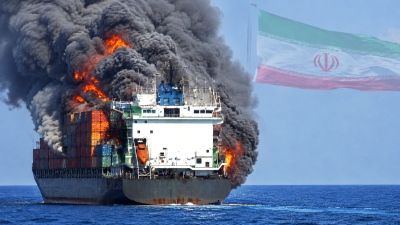
The Revolutionary Guards announced that the missile attacks they launched on Kuwait and Bahrain as retaliation for US strikes should serve as a lesson for the Americans. "Late last night, the aggressive American military struck an Iranian oil tanker near the Strait of Hormuz with an aerial missile, causing damage to the ship's engine room. In response to this aggressive act and the violation of the regulations governing navigation in the Strait of Hormuz, a ship of the American-Zionist enemy named Panaya was targeted by missiles launched by the Navy of the Revolutionary Guards," they stated in their announcement, noting that subsequently, the US military struck an IRGC communications tower on Qeshm Island. "In response, the Aerospace Force of the Revolutionary Guards carried out missile and drone attacks against an air and helicopter base located in one of the countries in the region, as well as against the headquarters of the 5th Fleet of the United States," the announcement states.
We had warned, do not touch Hormuz
The Revolutionary Guards claimed they had warned in advance that any aggressive action would be met with a "different and tougher response." "We had warned that any act of aggression would meet a different and more severe reaction, and we acted accordingly. These responses should serve as a lesson. We reiterate that disrupting the security of the Strait of Hormuz will carry a heavy price for the aggressive American military," the announcement concludes.
Esmail Kowsari (Iranian MP): Harder response to the US
Iranian MP Esmail Kowsari called on the country's armed forces to confront the United States "much more dynamically," arguing that the Americans "do not understand anything other than the language of power and force." As reported by the Iranian news agency Tasnim, Kowsari, a member of the National Security and Foreign Policy Committee of the Iranian parliament, made these statements in response to the recent announcement by the Islamic Revolutionary Guard Corps (IRGC), which called for intensified reactions against what it described as hostile acts by the United States. "American actions must be met with a much more powerful response," Kowsari reportedly said, emphasizing that, in his view, deterrence can only be achieved through a show of military power. His statements reflect the climate prevailing in circles of the Iranian political and military establishment after the recent escalation of tension between Tehran and Washington in the Persian Gulf region.
Message to Kuwait, Bahrain: You are also responsible
However, Iran's stance regarding the… responsibility that Kuwait and Bahrain bear for the American attacks makes a particular impression... In a statement, the Iranian Foreign Ministry stated that Kuwait and Bahrain bear "direct and clear responsibility" for the attacks, claiming that the two countries' territory and military installations were used to support American military operations against Iran. According to Tehran, the use of military bases and infrastructure by third countries for attacks against the Islamic Republic makes them complicit in the consequences of the operations. The Iranian Foreign Ministry also stressed that the country reserves the right to self-defense, as provided for by international law. "The Islamic Republic of Iran reserves the right to defend itself and will use all available means to respond to any aggressive action, including targeting the source of future attacks," the statement said. This declaration further escalates tension in the Persian Gulf, as it suggests that Iran now considers not only the United States but also the countries hosting American military facilities as potentially responsible for future military actions against it.
Kuwait in ashes
At the same time, Kuwait announced that it is suspending flights following Iranian attacks on the airport that caused injuries. The Kuwaiti army announced that the Iranian drone and missile attacks, which struck a terminal at Kuwait International Airport, caused "significant material damage" to the building and injured several people. According to the announcement, the injured received immediate medical attention, while no further details have been given regarding their health condition. The same announcement was released by Kuwait's General Directorate of Civil Aviation, as reported by the official Kuwait News Agency (KUNA). The Civil Aviation Authority also announced that all flights to and from Kuwait International Airport have been suspended until further notice, while aircraft will be diverted to alternative airports until safety and the smooth operation of the airport are restored.
Kuwait under attack
— Baba Banaras™ (@RealBababanaras) June 3, 2026
Iran launched multiple missiles targeting America bases in Kuwait. Total 12 missiles and over a dozen drones have been launched in 2 waves of renewed attack of Iran.
More details soon pic.twitter.com/VkmzDBI1mK
Kuwait: Iran's attack is criminal
A senior official of the Kuwaiti army condemned the Iranian missile and drone attacks against the country, which caused an as-yet-unknown number of injuries and led to the suspension of operations at Kuwait International Airport. Brigadier General Saud Abdulaziz Al-Otaibi, a spokesman for the Kuwaiti Ministry of Defense, described the strikes as a "criminal Iranian aggressive act." "The criminal Iranian attack caused significant material damage to the building and injuries," Al-Otaibi said. So far, it has not been clarified how many people were injured during the attack on the airport or how serious their condition is. Kuwaiti authorities have suspended the operation of the airport and are diverting flights to alternative destinations, while the assessment of the damages and the investigation into the circumstances of the attack continue.
CENTCOM: The Iranians failed in their attacks in Kuwait
And while Kuwait expresses its outrage at the Iranian attack, the United States Central Command (CENTCOM) appeared… particularly reassuring, claiming that none of the targets of Iran's attacks… were achieved. Earlier, CENTCOM had announced that it had carried out "self-defense" fire in response to "attempted attacks by Iran in various locations in the Middle East." "Iran launched several ballistic missiles toward neighboring countries in the region, however, none hit their intended target," CENTCOM stated in a release. CENTCOM's announcement contrasts with previous reports from Iranian and Arab sources, which spoke of attacks on American facilities in Kuwait and Bahrain, as well as the activation of air defense systems and explosions near military bases.
Attack on Bahrain and United Arab Emirates
Arab sources reported that warning sirens sounded at American military bases in Bahrain. According to the same information, warning systems were activated, while anti-aircraft defenses deployed at the US bases were put into operation. At the same time, strong explosions were reported at the headquarters of the 5th Fleet of the United States in Bahrain, as well as at the Al Jafair air base. Earlier, US military facilities in Kuwait were reportedly targeted by missile and drone attacks. Sources spoke of explosions in the Al Surra area, south of the capital, as well as at the Ali Al Salem air base, where US forces are stationed, and the Arifjan base in southern Kuwait. Attacks were also reported on the al-Dhafra, al-Safaran, and Al-Manhad bases in the United Arab Emirates.
Message from Bahraini army: We will protect the country
The Bahraini army announced that it intercepted three missiles and several drones that were targeting civilian infrastructure, attributing the attacks to Iran and what it characterized as "systematic aggressive behavior." The Bahraini Armed Forces condemned the Iranian strikes as a violation of international law, emphasizing that they remain at full readiness to protect the country. "The General Staff of the Bahrain Defense Force announces that Iran is continuing its systematic hostile campaign through criminal missile and drone attacks targeting civilian facilities in the Kingdom of Bahrain," the official announcement states. Bahraini authorities emphasized that air defense systems functioned effectively, intercepting the threats before they hit their targets, while reiterating their commitment to continue defending the national security and citizens of the country.
Why the Americans are striking Qeshm Island, Iran's unsinkable aircraft carrier
Qeshm Island, once a quiet free trade zone and tourist paradise, known for its UNESCO-recognized Geopark, has been transformed into a front-line military fortress. Covering an area of approximately 1,445 square kilometers, Qeshm is the largest island in the Persian Gulf and controls the entrance to the Strait of Hormuz, the most important transit point for energy cargoes globally. The island's unique geographical position and heavily fortified infrastructure make it a primary target for the US military for several reasons. Specifically, Qeshm Island is a target for:
• Underground networks: Qeshm acts as an "unsinkable aircraft carrier" for Iran. Its underground networks and labyrinthine salt caves are used to conceal highly classified coastal missile systems and high-speed attack craft.
• "Missile cities": Beneath the surface of the island, Iran has developed coastal missile facilities oriented toward naval warfare, with the explicit goal of controlling or even closing navigation in the Strait of Hormuz.
• Control of global energy corridors: Because Iran has used Qeshm as a base to intercept or restrict the passage of oil and gas tankers from the Strait of Hormuz, the US military considers the island a nerve center in the wider energy competition of the region.
• Line of retaliation: The island has evolved into a frequent flashpoint in the exchanges of fire between the US and Iran.
For example, following previous escalations, during which Iran targeted US facilities in the region, the US carried out targeted strikes that it described as "self-defense" actions against positions of the Islamic Revolutionary Guard Corps (IRGC) and communications infrastructure on Qeshm, with the aim of limiting Iran's ability to disrupt navigation in the Strait of Hormuz.
Rubio (US Secretary of State): Iranian generals had a plan
However, the statement by US Secretary of State Marco Rubio, who, referring to the decision-making process in Iran, said that at the beginning of the conflict the responsibility for decisions had been largely transferred to Iranian military commanders, with the result that many critical decisions were taken directly at the field command level, also makes an impression. "It is absolutely clear that, at the start of the conflict, they had transferred decision-making authority to field commanders. Unlike the American system, where the president, the Secretary of Defense, or the Chairman of the Joint Chiefs of Staff make the orders and decisions directly, in the Iranian system, many decisions are taken at the level of military command," added Rubio, noting that many actions and operational decisions were carried out without requiring approval from the top political leadership. This statement was made in the context of the discussion about the way in which Iran reacted during the first days of the conflict and the level of control that the central leadership exercised over military operations.
Iran is not a "paper tiger"
Israel's ongoing military campaign against Iran may be less about "security" goals and more about one man's political survival, estimates Colin Clarke, executive director of The Soufan Center. "I don't even see it as a matter for the Israelis as a whole. I see it as a matter for Benjamin Netanyahu and his need to keep the war machine running in order to avoid being held accountable by the Justice system," Clarke told Al Jazeera. "When the music stops, you have to find a chair to sit in, and Netanyahu is facing immense pressure inside Israel," he added. Clarke argued that the war cannot continue indefinitely without Washington's support and that the final decision lies in the hands of Donald Trump. "There will be no continuation of this war without American support. Netanyahu may persuade President Trump to start a war, but President Trump can also reverse that pressure and end it," he stated. According to him, the main issue is for Washington to recognize the limits of military power. "The Iranians are not going to surrender completely nor capitulate. This is not a paper tiger that you can overthrow overnight, like Venezuela. When this is understood, then I believe there can be a solution," concluded Clarke.
US-Iran peace unlikely, more likely scenario… a prolonged ceasefire
Alan Eyre, a former American diplomat and fellow at the Middle East Institute, estimates that even if the current conflict between the United States and Iran is ended, this does not mean that peace will prevail in the region. "The Iranians have been attacked twice. They believe that Israel seeks regime change and that the United States wants the same. Therefore, there is not going to be peace – the best we can hope for is a prolonged ceasefire," Eyre said, speaking to Al Jazeera. According to him, Iran will remain in a state of military readiness, will seek to reorganize its armed forces and replenish its missile arsenal, while it is likely that it will attempt to acquire a nuclear weapon. "This was not the case before the war," he stressed. Eyre noted that before the conflict, Iran was considered a "nuclear hedging state," meaning a country that maintained the technological capabilities for the development of nuclear weapons without, however, having proceeded to weaponize them. In his view, the hardline approach followed by the United States has changed Tehran's strategic calculations, increasing the incentives for acquiring nuclear deterrent power. The former diplomat estimates that, even if hostilities are limited, the mistrust between the two sides will remain deep, making any substantive and lasting peace agreement difficult in the immediate future.
"Trump's failed war against Iran gave him nothing"
In an opinion piece by Kenneth Roth, the British newspaper The Guardian argues that Donald Trump's failed war against Iran did not yield any substantive benefit for the American president. "The President of the United States has essentially returned to square one and is now seeking to sign the same deal that Tehran had concluded with the administration of former President Barack Obama." The Obama-era agreement limited Iran's uranium enrichment to 3.67%, while Tehran had sent about 11 tons of uranium to Russia. However, Trump withdrew from the agreement in 2018, abolishing the restrictions that had been imposed. The report argues that the unplanned war against Iran failed completely and that Trump, who describes himself as a "master of deals," now finds himself in a position where he is called upon to accept a draft agreement that is considered politically humiliating.
Iran emerged stronger
According to the report, after the military attack by the US and Israel against the Islamic Republic, Trump – prompted by Benjamin Netanyahu – hoped that the targeted attacks against the Iranian leadership would lead to the overthrow of the government. However, not only did a collapse of the Iranian regime not occur, but the country's political and social cohesion was strengthened. At the same time, it is noted that the disruption to navigation in the Strait of Hormuz, from where before the conflict about one-fifth of global oil and liquefied natural gas trade passed, created intense inflationary pressures on the American economy and burdened the prospects of the Republicans in the November midterm elections.
The concessions Tehran is asking for
According to the report, Tehran is aware of the pressure Washington is facing for the reopening of the Strait of Hormuz and is taking advantage of the situation by asking for unprecedented concessions. The article underscores that even issues which the Trump administration had set as key goals of the war – such as Iran's ballistic program and support for the Hamas and Hezbollah organizations – do not appear to be included in the framework of a possible deal. According to the columnist, the only realistic solution is the acceptance of limited uranium enrichment under strict international controls, an approach that the JCPOA followed.
Criticism of Trump and Netanyahu
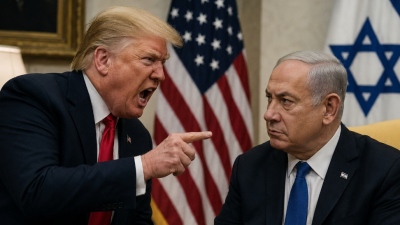
The Guardian argues that Trump should have used military power only as a last resort and exclusively within the framework of the United Nations Charter. At the same time, it is argued that the American president owes it to distance himself from the strategy of continuous war conflicts attributed to Benjamin Netanyahu and place national and international interests above his personal ambitions. The report concludes that Trump should accept this "obvious defeat," even if that means he will cease to be considered a "master of deals" and will be characterized, ironically, as an "awkward negotiator."
www.bankingnews.gr





Σχόλια αναγνωστών